
Reviewed · GRAFFITI TOURS
Graffiti Tour: a fascinating walk through a street art City
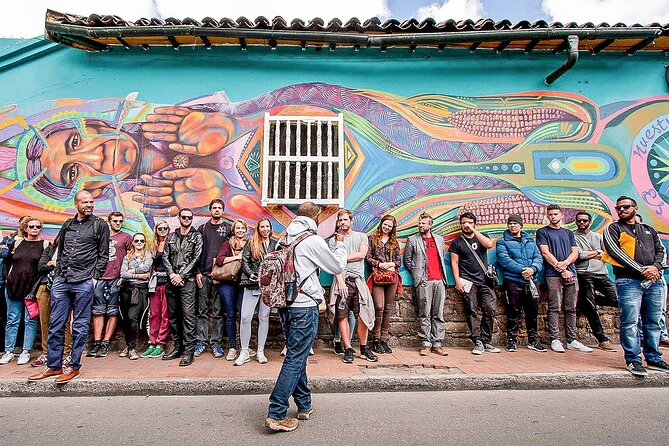
Bogotá street art is interesting because the walls act like news, protest signs, and community memory, all at walking speed. I love how this tour links murals to real social issues, and I also like that the English-speaking guides explain what you are looking at without turning it into a lecture. You get a guided route through major works, from human-rights murals to salsa culture walls, all in about 2 hours 30 minutes.
One possible drawback: this is an active, street-level walk, and it is not recommended for travelers with mobility restrictions. If that is you, you might want a different kind of tour with fewer steps.
Key Highlights You Should Know Before You Go
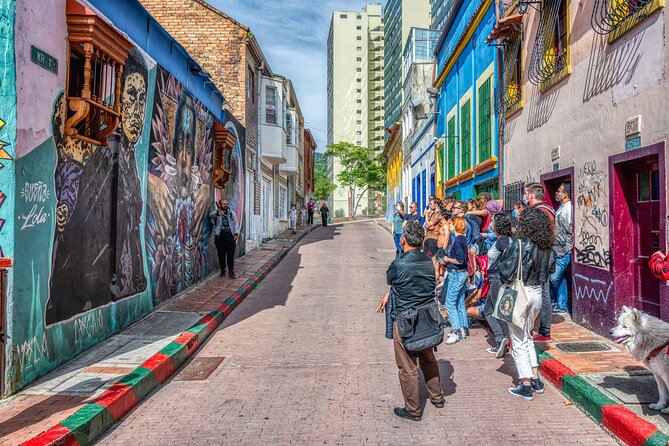
- A tight, 17-stop route that keeps moving but still gives you time to read each wall
- Free entry at the stops listed on the itinerary, so your $15 goes to the guide and experience
- Social themes everywhere, from food sovereignty and migration to Comuna 13 and Operation Orion
- Street art techniques in plain view, including stencils and the contrast between aerosol and vinyl
- Music shows up too, including murals tied to Lágrimas Negras and salsa club culture
- Hands-on participation at the end, with an abstract letter game connected to aerosol workshops
Why Bogotá Graffiti Feels Like Real City Reading
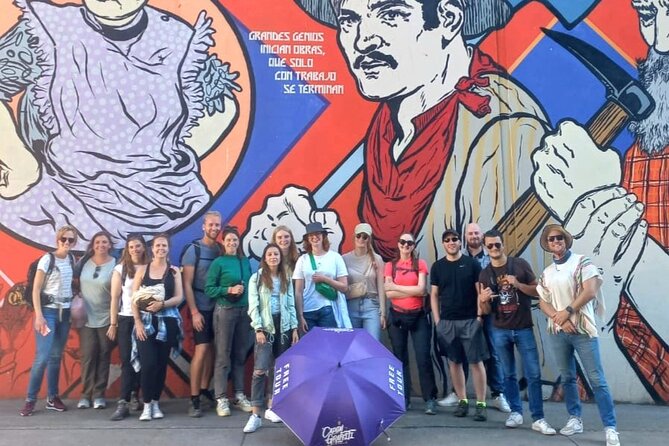
If you only look at street art as decoration, Bogotá can feel overwhelming. This tour solves that fast. You walk a planned route, and your guide turns each wall into a short chapter about Colombia’s recent social and political life. You start seeing patterns, like how artists respond to human rights pressure, migration realities, and conflicts that families still feel.
Two things make it especially satisfying. First, the murals are not random. They are tied to named institutions and events, like work connected to social leaders and human rights defenders, and murals shaped by journalism. Second, the guides bring context in a way that is easy to hold in your head as you keep walking. People mention guides like Cami, Jay, and Marco, and the theme is consistent: they connect the art to the social reality behind it, not just the style.
More City Tours in Bogotá
- Bogota: Bicycle City Tour
★ 4.9 · 2,156 reviews - La Candelaria, Monserrate and Museums Bogotá Private City Tour
★ 5.0 · 1,567 reviews - Bogota + Monserrate Private City Tour, Museums, Candelaria.
★ 5.0 · 1,015 reviews
Price and Timing: What $15 Buys in the Real World
At $15.00 per person for about 2 hours 30 minutes, this is one of those Bogotá deals where you feel your money spent on people, not paperwork. You also get a long list of stops, including several that note free admission at the visit point. That matters because street art tours can quietly charge you extra through entry fees or paid museums.
This format also helps your brain. You are not stuck in one neighborhood for hours. You are moving between different themes and art languages, which is ideal if it is your first time in Bogotá and you want orientation. The tour also runs with a maximum group size of 15 travelers, which tends to keep questions from getting lost and helps your guide manage pace on crowded sidewalks.
Your Route From Capital Graffiti Tours to Ocio Gallery
You will start at Capital Graffiti Tours, Cra. 6 #15-88, Santa Fé, Bogotá. The tour wraps at Ocio Gallery, Cra. 5 #26b-26, Bogotá, where there is an exhibition space showing more than 100 artists’ works. That ending is practical. You finish with a better sense of what you learned outside, then you can keep browsing inside without feeling like you are rushing out into the street.
The overall itinerary is built from short viewing moments. Many stops are around 5 minutes, with a few longer ones like the Gold Museum area at about 10 minutes and a mural cluster with more time at the Parqueadero Moto stop (about 15 minutes). Translation: you will see a lot, so wear shoes you trust.
Stop-by-Stop: The Murals and Why They Matter
More Graffiti Tours in Bogotá
- Graffiti Tour in La Candelaria Bogotá
★ 5.0 · 315 reviews - Bogotá: La Candelaria Graffiti & Urban Art Guided Tour
★ 4.7 · 250 reviews - Fun Graffiti Workshop: The Art of Aerosol and Color
★ 5.0 · 73 reviews - Graffiti Tour in La Candelaria Bogotá with Transportation
★ 5.0 · 68 reviews
1) Gold Museum (Start Point)
You begin in front of the Gold Museum, where your guide welcomes you and sets expectations for the tour’s goals. Even if you do not go inside during this walk, this location anchors you in a part of Bogotá that signals value, heritage, and national identity. It is a smart warm-up, because it cues you to look for meaning, not just color.
Admission is listed as free for this stop, and the time is short, about 10 minutes, so you are not left standing around.
2) Procuraduría General de la Nación: Human Rights and Food Sovereignty
Next comes a huge mural at Procuraduría General de la Nación. It features images made in collaboration with social leaders and human rights defenders, with themes tied to violence threatening their work for food sovereignty. The mural uses metaphorical imagery and social-communication skills to portray the leaders’ values, not just their faces.
If you only look for aesthetics here, you miss the point. Your focus should be on how the mural frames survival, risk, and community purpose.
3) Parqueadero Público: Migration and an Indigenous Girl’s Portrait
At parqueadero publico, you will see a mural recognizing migration challenges, featuring a portrait of an indigenous girl from a nomadic Indigenous community. This one is interesting because it was commissioned by the Peruvian embassy, and created by two women painters, one from Bogotá and one from Lima.
Look closely at how the work personalizes migration, not as a headline but as a specific identity and story.
4) Casa Quiebracanto (Quiebracanto): Salsa as Culture, Memory, and Space
At Quiebracanto, the tour shifts to music culture with two salsa-related murals. One represents Lágrimas Negras (Black Tears). The other shows a lively dance scene in a famous salsa nightclub.
This is a great reminder that street art is not only protest. It also records everyday culture, sound, and the places where people gather.
5) Torre Bakatá: The Tallest Illegal Graffiti
Then you reach Torre Bakatá, described as the tallest illegal graffiti in the country on a semi-abandoned skyscraper. This stop is quick, but the idea lands. Illegal work often signals urgency, resistance to censorship, or a desire to be seen at scale.
Because the structure is semi-abandoned, you should keep your attention on safety and footing while you take it in.
6) Viuda Negra Tattoo Gallery: Aerosol vs Vinyl, Under a Hooded Gaze
At Viuda Negra Tattoo Gallery, a mural shows an indigenous person placed under the watchful gaze of a hooded woman. The artwork explores contrasts between aerosol and vinyl techniques.
This stop is a good one for technique spotting. You can often tell different methods by how edges feel, how textures read, and how layered images look at a distance.
7) Parqueadero Moto: Spanish Artist Work, Travel Photographer Stencils, and Parenting Themes
This is one of the most “content-dense” stops. At Parqueadero Moto, you will see three murals:
- a mural created by a renowned artist from Spain, who gained prominence in the 1990s
- work by a prominent photographer who turns travel portraits into stencils
- a final mural focused on parenting and freedom, which invites psychological reflection
You get about 15 minutes here, and that extra time makes sense. There is a lot to notice, and your guide can connect the visual choices to the underlying themes.
8) Litografía CH: Venezuelan Migrant Stencil
At LITOGRAFIA CH, you will observe a stencil that highlights the experiences of Venezuelan migrants. This is short, but stencils often deliver messages with strong, immediate legibility.
A good way to approach this stop is to look at the composition first, then listen for what your guide says about the message and audience.
9) Park motos smokes shop CENTRAL: The History of Graffiti, From Cave Art to Public Space
At the wall at Park motos smokes shop CENTRAL, the tour points you to graffiti letters and characters that prompt reflection on the origins of graffiti, and the difference between muralism and graffiti. The guide frames it as a historical journey from cave art to public space art.
This is one of those moments where you start understanding street art as a long tradition of public communication, not a modern fad.
10) Torre Ventto: Political Posters and Stencils for Current Issues
Moving to Torre Ventto, you will explore an area filled with political posters and stencils addressing current social issues. This stop is about sharpening your eye. You should watch how the visuals are built to persuade or warn, often using bold shapes and direct messaging.
It is also a reminder that Bogotá street art is alive in real time, not just museum material.
11) Alianza Francesa Bogotá: Art, Science, and the Amazon Threat
At Alianza Francesa Bogotá, the tour visits a collaborative mural linking art, science, and the environment, raising awareness about threats facing the Amazon rainforest.
This is useful if you want your street art tour to connect to global issues, not only local politics. It also signals how institutions can support public art themes.
12) Superdorado de Aves: Indigenous Cosmovision and Cultural Heritage
Next is Superdorado de Aves, a mural paying homage to Indigenous cosmovision and cultural heritage. This stop often works well for first-timers because it gives you a different kind of meaning to look for, identity and worldview, not just events.
Give yourself a second to absorb the symbols and how the colors and forms suggest connection to place and belief.
13) Parqueadero Público la 3: Comuna 13 and Operation Orion, False Positives, Resilience
At Parqueadero Público la 3, you will see a mural about Comuna 13 and Operation Orion. It is based on powerful photographs by journalists and portrays the resilience of the community in the face of false positives.
This stop tends to hit harder than the salsa or technique moments. Here, the mural is functioning like testimony, using visual language to keep truth visible.
14) Cafetería La Ventantia: The Last Hitnu Indigenous Leader
At Cafetería La Ventantia, there is a stencil of the last indigenous leader of the Hitnu culture. The theme is the tension between development and cultural preservation.
Look at how the stencil format compresses a whole argument into a single figure. It is designed to be read, not just admired.
15) COOTRADIAN: A Letter Reading Game Linked to Aerosol Workshops
At COOTRADIAN, the tour switches to participation with an abstract letter reading game. The letters are created by famous graffiti writers, and the stop is also tied to aerosol workshops accessible to all.
Even if you are not into graffiti writing yourself, this is a clever way to learn how style and meaning connect. You start understanding why tags and letters become a language in public space.
16) Cl 20 #430: Murals of Social Demands
At Cl 20 #430, you will see murals highlighting social demands, created by four renowned political artists from Bogotá. The themes focus on foundations of society and social struggles.
This is a good stop for listening. Your guide can help you connect what you see to how political art is built to argue about society’s rules, not just about one issue.
17) The Spot Bogotá Centro: The Tallest Wall in the Country and a Sustainable Future
Finally, at The Spot Bogotá Centro, you reach the mural described as the tallest wall in the country. The artwork showcases diversity and gives you a space for reflection on a better future based on sustainable social development and the role of sustainable tourism.
This is a strong finish point because it turns street art from critique into a kind of civic imagination.
The Techniques You’ll Learn to Spot, Fast
One of the best parts of a graffiti tour is that you stop calling everything street art and start noticing differences. This route explicitly includes technique contrasts, like the aerosol versus vinyl discussion at Viuda Negra Tattoo Gallery.
And you will see multiple formats across the day:
- Murals designed for narrative and symbolism, like the human-rights and migration works
- Stencils used for strong, repeatable messaging, like the Venezuelan migrant stencil
- Letter-based graffiti ideas, which show up at the graffiti origins stop and in the abstract letter game at COOTRADIAN
- Combinations of art styles and sources, like photographer-turned-stencil work at Parqueadero Moto
If you want to get more out of the tour, ask your guide what each technique helps the artist do: faster production, clearer message, or more layered meaning.
Who This Tour Is Best For (and Who Might Skip It)
This tour is set up for most travelers, and it is limited to 15 people, so it should feel personal enough to ask questions. It is also a good match if you like learning history through present-day visuals, especially Colombian politics and social struggles.
It is not recommended for travelers with mobility restrictions, since the experience involves short stops across streets and sidewalks. If you are unsure, you can choose this only if you know you can handle frequent walking and standing.
Also, because it includes a mix of serious topics and cultural scenes, it works well for curious travelers, couples, and solo visitors who like their travel stories tied to real communities.
Should You Book This Bogotá Graffiti Tour?
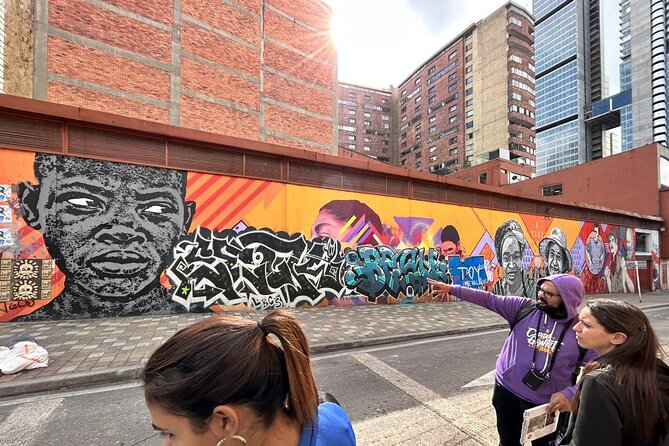
Book it if you want a Bogotá introduction that feels smarter than a quick photo walk. For $15, you get an English-speaking guide, a focused route with 17 stops, and a guided way to understand why these murals exist, from human rights and migration to salsa culture and indigenous heritage.
Skip it if mobility is a concern, because the format is built around walking between sites, most stops are quick, and it is not marketed as accessible. If you are good on foot, this is one of the best ways to understand Bogotá’s public art language in a single afternoon.
FAQ
How much does the Bogotá graffiti tour cost?
The tour costs $15.00 per person.
How long is the tour?
The experience lasts about 2 hours 30 minutes.
What is included in the price?
You get experienced English-speaking guides and the guided exploration of multiple street art and graffiti locations.
Are there any admission fees at the stops?
The itinerary lists admission tickets as free at the stops included in the walk.
How many people are in the group?
The tour has a maximum of 15 travelers.
Is the tour offered in English?
Yes. It includes English-speaking guides.
Where do I meet, and where does it end?
You start at Capital Graffiti Tours, Cra. 6 #15-88, Santa Fé, Bogotá. You end at Ocio Gallery, Cra. 5 #26b – 26, Bogotá.
Is the tour recommended if I have mobility restrictions?
It is not recommended for travelers with mobility restrictions.
Is food included?
No. Food and tips are not included.
Can I cancel for a full refund?
Yes. There is free cancellation, and you can cancel up to 24 hours in advance for a full refund.
More Walking Tours in Bogotá
- Bogotá: Guided La Candelaria Walking Tour
★ 4.8 · 1,229 reviews - Walking Tour in La Candelaria Bogotá
★ 5.0 · 859 reviews - Bogotá Tour: Monserrate, Food, City Walk & Botero Museum
★ 5.0 · 328 reviews - Bogotá: True Colombian Walking Tour + Local Snacks
★ 5.0 · 291 reviews
Recently reviewed around Bogotá
- Visit and live a colombian coffee plantation (group tour)★ 4.5 · 4 reviews
- Villa de Leyva Food Tour at Sunset★ 5.0 · 4 reviews
- Private Coffee Tour in Cachipay★ 5.0 · 4 reviews
- Bike Tour in Bogota★ 5.0 · 4 reviews
- Tour Nocturno de Tejo y Salsa en Bogotá★ 5.0 · 4 reviews
- Hike to the Rocky mountains of Sutatausa Private Day Tour★ 5.0 · 5 reviews
- Andrés Carne de Res Chía: VIP Entry with Cover & Welcome Cocktail★ 5.0 · 5 reviews
- Salt Cathedral Tour along with the Legendary Lake Guatavita★ 5.0 · 5 reviews
Graffiti Tours, compared.
Comuna 13 Graffiti Tour, Cable Car & Street Food
Read our review →

Comuna 13 Tour with Snacks And Your Own Graffiti
Read our review →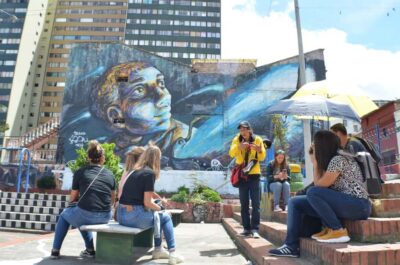
Comuna 13 and Graffiti Guided Tour with a Local
Read our review →
Historical Shared Tour Salsa, Graffiti & Resistance in Cali
Read our review →Browse the lists this tour appears in