Reviewed · BOGOTÁ TOURS
Pedaling in Full Color: Urban Art, and Cultural Diversity
This is one of the most fun ways to understand Bogotá: you ride through neighborhoods while a local street artist guides you wall by wall. It is urban art as a story, not a scavenger hunt. I love that the tour is built around meaning, with stops that connect murals to Colombia’s memory and push for a better future.
Two things I especially like: you get to see a ton of major works in a short ride, and you do it on a bike with real context from an artist-guide like Diego, Natalia, or Anna (depending on the day). One possible drawback: the pace is brisk, and many stops are short, so if you want long hangs at each mural, you may feel a bit rushed.
Key highlights
- Artist-guided route that explains why each mural exists, not just what it looks like
- 20 mural stops across multiple Bogotá neighborhoods in about 3 hours
- Indigenous, Afro-Colombian, and women-focused artwork tied to cultural identity and social change
- Major political and post-conflict themes, including colonial history and memory for peace
- Sunday option can feel extra bike-friendly if your day lines up with Bogotá cyclovia
Why a Bogotá graffiti bike tour works better than photos
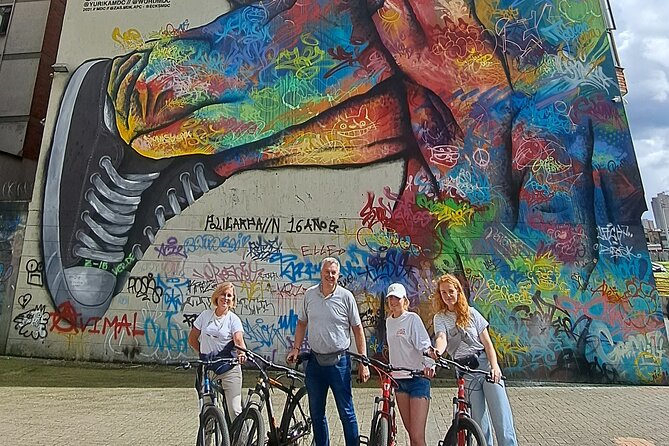
Bogotá’s street art can feel like a visual overload if you only stop and stare. On a bike, you keep moving, and the guide helps you read what you’re seeing. That matters because a lot of murals are doing more than decorating. They argue, mourn, celebrate, and sometimes push back hard at power.
This tour is built on a simple premise: committed street art has channeled the city’s resilient soul and the country’s memory into an inspiring message for a better future. You can feel that message in the mix of styles. You’ll see hyper-realistic spray, stencils, paste-ups, mosaics, and huge walls that force you to look up. And you’ll also hear how public walls become a kind of civic language in a city that has had plenty to process.
For your money, the best part is how much interpretation you get per hour. It is not just transportation, it is a guided reading of Bogotá’s street culture.
A few more Bogotá days worth comparing
- Bogotá Bike Tour
★ 5.0 · 3,329 reviews - Bogota: Bicycle City Tour
★ 4.9 · 2,156 reviews - Zipaquirá: Salt Cathedral Group Tour with Pickup
★ 4.8 · 1,606 reviews
Getting rolling at Cl 26b, with gear and real safety talk
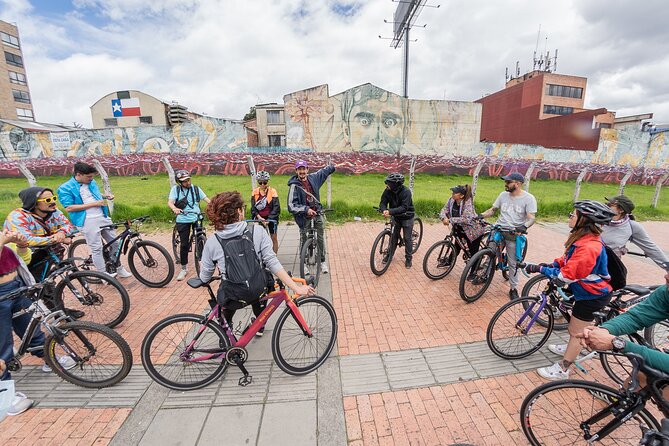
The ride starts at Cl 26b #4-13 and ends back there. You’ll meet your guide, get a quick introduction, and get the street art angle explained right away, so each stop lands with context instead of feeling random.
You are provided a bicycle, plus a helmet and a rain poncho. That is practical, and it also means you spend your energy on the art and not on logistics. The group is capped at 15 travelers, which keeps it small enough for questions without turning into a parade.
The guide will also share bike security tips before you roll. That shows up in how the tour feels in real life: people report feeling safe the whole time, and the vibe is easy going. If you are new to biking in cities, that matters. You’re not left guessing what to do at intersections or when to move.
One detail I like for planning: this tour often gets booked early. On average, it is reserved about 84 days in advance, so if you have specific dates, don’t wait around.
Stop 1 to 3: starting at the artist’s doorstep and the question of what graffiti means
Stop 1: Cl 26b #4-13 sets the tone. You begin with a warm welcome plus a personal introduction from your guide, who is a local street artist and promoter. The story argument is clear from the start: street art in Bogotá has become a channel for resilience and memory. You also get the bike security tips here, so you’re ready to move through the city without stress.
Then you head to Stop 2: Instituto Distrital de Patrimonio Cultural, Casa Genoveva. The highlight is a hyper-realistic spray piece featuring a child with a duplicated face. It creates double vision for the viewer, and it pushes you to think about innocence colliding with an urban environment. The guide also frames why it matters to see graffiti and minorities without jumping to quick judgments. In other words, you are learning how to look, not just what to look at.
Stop 3: Plazoleta Chorro de Quevedo brings cultural depth right into the street. You’ll admire murals that celebrate Indigenous and Afro-Colombian cultures. This stop also emphasizes community support. Local artists were commissioned to paint the walls as part of a mission to give back to the local art scene.
Practical note: these first stops are short, about 10 minutes each. You’ll want to stay mentally ready, because the tour keeps momentum. If you fall behind, you might miss the explanation that makes the art click.
Indigenous identity, water ecosystems, and a huge mural made with brooms and mops
After Chorro de Quevedo, the route shifts from cultural identity toward land, ecology, and scale.
Stop 4: Plaza de Mercado La Concordia looks at the idea of culture on everyday surfaces. You’ll see a farmers market facade transformed with lively murals showcasing Colombian farmers’ culture. It’s a reminder that street art is not only about protest. It can also honor daily life.
Stop 5: Skal Bogotá is the showstopper in technique. You’ll witness a giant mural created with an impressive painting process using brooms and mops by Bastardilla. The artwork portrays a child launching a shooting star with a slingshot. It’s whimsical on the surface, but the guide nudges you to think about wishes, longing, and what kids are allowed to hope for in the real world.
Stop 6: Edificio Venado de Oro connects street art to biodiversity and water. The mural highlights frailejon and paramos, Colombia’s highland wet ecosystem. Even if you know little about paramos, the point lands quickly: these ecosystems matter because they connect to water and life.
A possible drawback here: you will be cycling between neighborhoods, then stopping in clusters. If you are sensitive to noise or crowds near major mural zones, plan to pause and let the guide finish their explanation before you move again.
A different kind of day out of Bogotá:
- La Candelaria, Monserrate and Museums Bogotá Private City Tour
★ 5.0 · 1,567 reviews - Shared Tour of the Historic Candelaria in Bogotá
★ 5.0 · 1,551 reviews - Bogotá: Guided La Candelaria Walking Tour
★ 4.8 · 1,229 reviews - Graffiti Tour: a fascinating walk through a street art City
★ 5.0 · 1,074 reviews
Women’s voices and colonial tensions: music stencils, statue removals, and the highest graffiti
Next, the art turns toward women, political fractures, and colonial history.
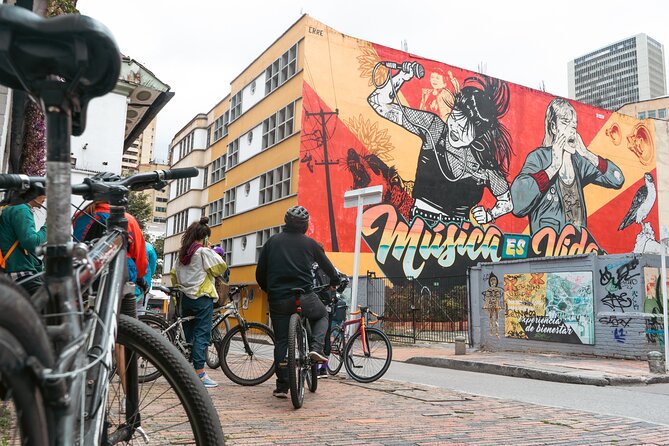
Stop 7: Parqueadero features La Musica es Vida, a giant stencil mural paying homage to female singers in Colombia, commissioned by a major music festival. This is the kind of mural that rewards time. Stencils can look simple, but when they are scaled up, they carry a poster-like intensity that makes the women at the center feel like icons.
Stop 8: Plazoleta del Rosario is an art and politics stop. You explore an empty pedestal where the Misak indigenous nation removed a conquistador statue. It’s a direct conversation about tensions, colonialism, and how those pressures show up in contemporary artistic expression. From there, you also witness the highest vandal graffiti on a nearby skyscraper. The guide uses it to talk about where lines get drawn, and who gets blamed when the message is inconvenient.
Stop 9: LAGA shifts the format again. Here you encounter political paste-ups with social and political messages. The focus is on hunting subtle meanings and hidden images. This is a stop for people who like to look closely and enjoy the mental game of spotting what’s not obvious.
Stop 10: Panamericana Centro, Carrera 7 con 12 returns to a recognizable portrait style. You’ll admire a stencil mural featuring a Wayuu Indigenous woman against a backdrop inspired by her intricate weavings. It’s a smart visual link between identity and craft, showing that culture isn’t only history, it’s pattern, technique, and daily expression.
Birds over Bogotá, anti-banking art, bulls, and why street walls argue back
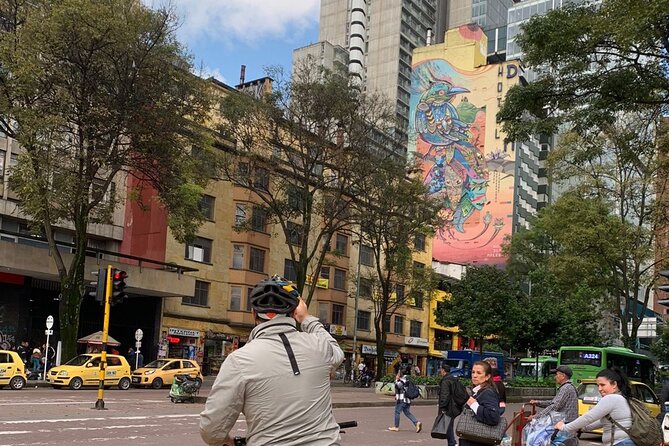
Now you zoom out again to see how Bogotá’s murals cover everything from nature to economics to cultural controversy.
Stop 11: Plaza de Las Nieves presents a giant mural of colorful birds in flight, representing Colombia and Bogotá’s biodiversity. It is a clean reminder that “street art” can mean environment and not only human drama.
Stop 12: BancoColombia Mercantil brings politics to the front. You’ll witness a powerful political mural opposing the influence of the banking industry. The mural does not try to be neutral. It takes a stance, and the guide helps you read it as part of Bogotá’s wider culture of debate on public walls.
Stop 13: Plaza de Toros Santamaria keeps the tension going. You ride along a street near the bull ring arena adorned with 20 murals created by national and international artists, some of which convey messages against bullfighting. This stop is useful if you want to understand how street art can reflect conflicts inside culture itself, not just conflicts imported from outside.
Stop 14: Barrio Armenia adds community flavor. You explore walls adorned with illustrations by female artists, plus community-driven work in gardens. The idea is that art can be both visual and physical, something a neighborhood maintains rather than something it only watches.
And then you start moving into the heavier emotional zone.
Social leaders, memory for peace, and the story walls that hit hardest
This is where the tour feels most serious, and it is handled through storytelling.
Stop 15: Casa Kilele pays tribute to social leaders who have lost their lives in Colombia. You’ll listen to storytelling and gain insights about the conflict in Colombia. This is not abstract. The guide ties art to real names and the human weight behind them.
Stop 16: Centro de Memoria y Reconciliación is Mosaic of Memory for Peace. You’ll visit a mural adorned with corn seeds, funded by the Center of Memory, Peace, and Reconciliation. The corn seeds represent the journey toward peace. Visually, it is strong and simple. Emotionally, it lands because it points to growth rather than just loss.
Stop 17: Cafe de la fonda is also a pause. You take a 15-minute break to learn about the decriminalization of street art and a decree that supports it. While you’re there, you can taste local coffee and beer, but these are not included in the tour price. I like this stop because it gives you the legal and cultural backdrop, so you stop thinking of street art only as vandalism or beauty. You see it as something a society is actively arguing about.
If you get tired, this is your reset point. Some people appreciate that the tour includes rests when needed, and this break is part of that rhythm.
Stop 18: Santa Fe returns to peace themes with a mural symbolizing peace and post-conflict in Colombia. It features a monkey transforming blackbirds using a cumbia instrument. The mix of image and music is the point: it suggests transformation, recovery, and cultural continuity through rhythm.
The final iconic murals: compassion, children’s portraits, and a tall-city ending
You end with two big emotional and visual closers.
Stop 19: Cl. 26 #13-69 is the tour’s most iconic wall. You’ll see a 10-floor mural based on a photograph showing tenderness shared between two homeless individuals in tough circumstances. It is compassion made monumental. The guide frames it as a shift in how we see people who are often pushed out of sight.
Stop 20: Spotty Bogotá finishes with the tallest mural in Colombia. It represents cultural and natural diversity as the country’s main wealth and a tool for a better future, through portraits of children from different areas and cultures in downtown Bogotá. The effect is hopeful, but not naive. The hope is tied to variety and to giving kids a future that reflects who they are.
At the end, you ride back to the starting point at Cl 26b #4-13.
Value, pacing, and who this tour is best for
For $56.18 per person and about 3 hours, you get a bike, helmet, rain poncho, and a concentrated art education across many stops where entry is free. The value comes from the guide’s role as an interpreter. You’re paying for time with an artist who can connect technique and symbolism, plus help you understand why these works matter socially.
The pace can feel like action if you like museums with short captions and moving fast. If you prefer slow art contemplation, plan to treat the stop explanations as the main course. You can still look longer at the mural when the group moves on, but don’t expect a long sit-down at every wall.
This tour fits you if:
- You want street art with context, not just photo ops
- You like bikes and want to cover districts efficiently
- You care about social themes like Indigenous rights, Afro-Colombian culture, women’s voices, colonialism, and memory for peace
- You want to feel safe and supported on a city bike ride with security tips
It might not fit you as well if:
- You hate cycling between many stops
- You need lots of time at each location to fully absorb the art
- You are emotionally worn out by post-conflict themes and political messaging
Should you book Pedaling in Full Color: Urban Art, Cultural Diversity?
I’d book it if you want the fast path to seeing a serious chunk of Bogotá street art and understanding why it exists. The small group size, the artist-guide angle, and the sheer number of major murals in 3 hours make this one of the most efficient art experiences in the city.
Go for it especially if you can handle a brisk schedule and you like your travel with meaning. And if you can time it for a Sunday when Bogotá cyclovia is happening, you’ll likely feel even more at ease on the roads.
FAQ
What is included in the tour price, and what is not?
The tour includes use of a bicycle, a helmet, and a rain poncho. Coffee and other tastings are not included, though you can have a tasting during the cafe break.
How long is the Bogotá bike tour?
It runs for about 3 hours.
Where does the tour start and end?
The tour starts at Cl 26b #4-13 in Bogotá and ends back at the same meeting point.
How big is the group?
The tour has a maximum of 15 travelers.
Does the tour include coffee or other tastings?
Coffee and other tastings are not included in the tour price. There is a 15-minute cafe break where you can taste, but you would pay on your own.
Can I cancel for a full refund?
Yes. You can cancel up to 24 hours before the experience’s start time for a full refund. If you cancel less than 24 hours before the start time, the amount you paid will not be refunded.
Recently reviewed around Bogotá
- Visit and live a colombian coffee plantation (group tour)★ 4.5 · 4 reviews
- Villa de Leyva Food Tour at Sunset★ 5.0 · 4 reviews
- Private Coffee Tour in Cachipay★ 5.0 · 4 reviews
- Tour Nocturno de Tejo y Salsa en Bogotá★ 5.0 · 4 reviews
- Bike Tour in Bogota★ 5.0 · 4 reviews
- Hike to the Rocky mountains of Sutatausa Private Day Tour★ 5.0 · 5 reviews
- Andrés Carne de Res Chía: VIP Entry with Cover & Welcome Cocktail★ 5.0 · 5 reviews
- Salt Cathedral Tour along with the Legendary Lake Guatavita★ 5.0 · 5 reviews
Bogotá Tours, compared.
Zipaquirá: Salt Cathedral Group Tour with Pickup
Read our review →
La Candelaria, Monserrate and Museums Bogotá Private City Tour
Read our review →
Shared Tour of the Historic Candelaria in Bogotá
Read our review →
Graffiti Tour: a fascinating walk through a street art City
Read our review →